
For more than a century, football has been defined by one simple rhythm, that is, two uninterrupted 45-minute halves.
The continuous flow of the game has always separated it from many other major sports, where play is frequently paused for timeouts and commercial breaks. But that rhythm could feel slightly different when the 2026 FIFA World Cup begins at North America.
Less than 100 days remain to the World Cup and exclusives have started flowing in. According to The Athletic, FIFA has confirmed that every match in the tournament will include mandatory three-minute hydration breaks midway through each half.
The governing body has promoted the move as a “player welfare measure,” especially with games set to be played across venues in United States, Canada, and Mexico.
However, the rule carries another important implication. The official broadcasters will be allowed to cut away to advertisements during these breaks.
What appears to be a simple change designed to help players recover could quietly reshape how football’s biggest tournament is watched. It has already sparked debate about whether the World Cup is beginning to adopt a more American-style broadcast model.
Water Break or Ad Break? FIFA’s 2026 World Cup change could quietly reshape football broadcasts
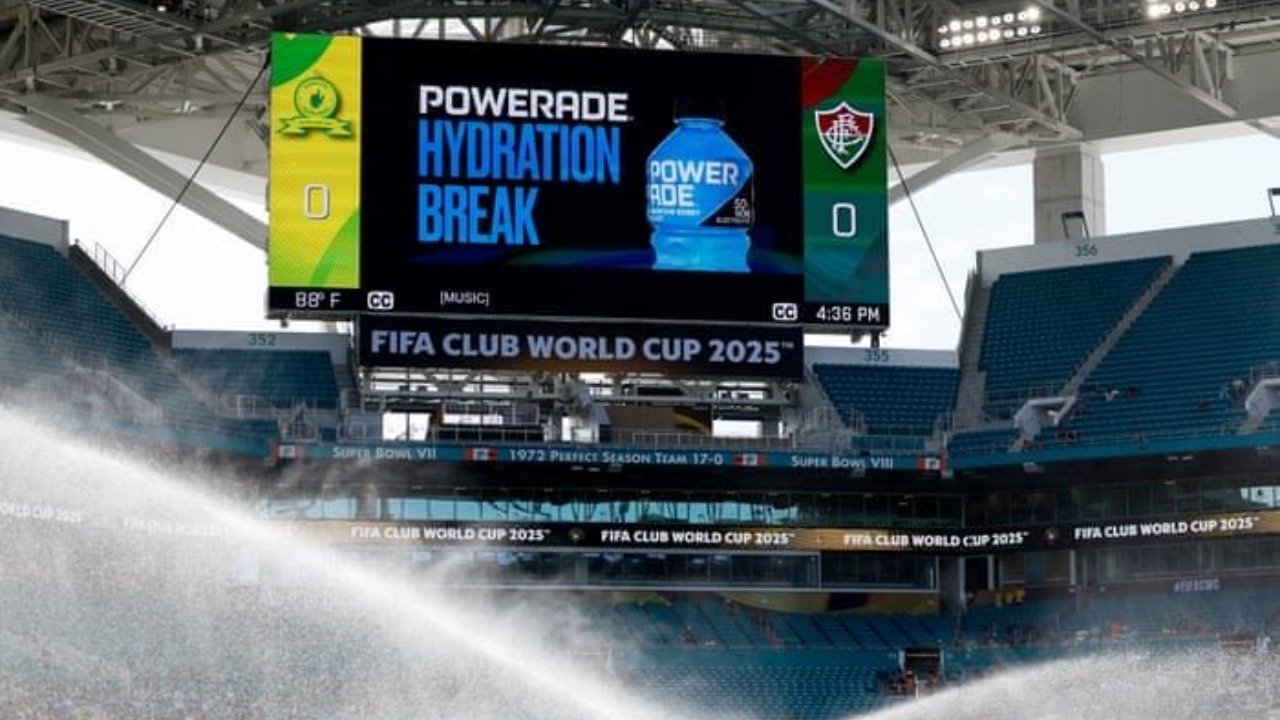
Under the new rule, referees will stop play roughly around the midpoint of each 45-minute half, giving players a three-minute window to hydrate and cool down.
Unlike previous tournaments where cooling breaks were introduced only when temperatures reached dangerous levels, these pauses will now be mandatory in every match.
For players, the break offers a short chance to regroup physically and tactically. But for broadcasters, it also creates something football rarely provides — a predictable advertising window during live play.
Television networks that have paid enormous sums for World Cup broadcasting rights will be able to briefly switch to commercials before the match resumes. In practical terms, the traditional 45-minute halves will now feel closer to two shorter segments separated by a broadcast interval.
Why the criticism?
Part of the criticism surrounding the decision comes from the fact that cooling breaks are not new to football. For years, competitions around the world have introduced hydration pauses when temperatures climb above 32°C, allowing players to safely cope with extreme conditions.
Those breaks, however, were situational rather than mandatory. They were used only when weather conditions demanded them.
The 2026 World Cup introduces something different. Regardless of temperature, every match will now include these mid-half pauses. With the tournament expanding to 104 matches, that decision adds up to a substantial amount of additional stoppage time across the competition.
By some estimates, the tournament could include around 624 minutes. This indicates more than 10 hours of enforced mid-game breaks. For critics, that number is difficult to ignore.
If cooling breaks already existed when the weather required them, introducing them universally inevitably raises questions about whether the decision is purely about player welfare.
The “Americanization” debate around FIFA World Cup 2026
The controversy has also revived a familiar discussion in football, that is, whether the sport is slowly adapting to the broadcast structure common in American sports.
Leagues such as the National Football League and the National Basketball Association are built around frequent stoppages that allow broadcasters to insert advertisements throughout the game.
Football, by contrast, has traditionally resisted that format, with its uninterrupted halves forming a key part of the sport’s identity.
The introduction of mandatory mid-half breaks in the FIFA World Cup does not fully replicate that system, but it moves football closer than ever to a segmented broadcast model.
FIFA insists the decision is primarily about protecting players in demanding conditions. And there is no doubt that short hydration pauses can help athletes recover, especially during intense summer tournaments.
Yet the numbers, signalling over 10 hours of enforced breaks across the World Cup ensure that the debate will continue.

