
The latest innovation of NVIDIA was meant to be a revolutionary moment for PC gaming graphics. However, it sparked “supporting…slop” backlash from the community, which it thought would impress. NVIDIA unveiled DLSS 5 at GTC 2026. The company showed the world a neural rendering tech that adds photorealistic lights as well as materials in gaming. However, the community took to social media, making comparisons of it with AI-generated content. There were memes mocking its generated hyper-realistic faces, as well as concerns about the future of artistic integrity within gaming development.
DLSS 5’s photorealistic promise by NVIDIA meets with backlash
NVIDIA shocks everyone introducing new DLSS 5 that represents quite a significant leap within tech, in consideration of its predecessors. Unlike previous versions, which focused just on boosting performance, the iteration introduced some real-time neural rendering, which alters how gaming graphics get processed. The tech by NVIDIA added Hollywood-level visual effects to major gaming studios’ games, including Bethesda and Capcom, with Digital Foundry describing the results as astonishing in terms of their visual fidelity.
However, the response coming in from the gaming community told a different story. An X user comparing the character transformation, suggested, “No this isn’t a joke. It’s real 💀 I genuinely don’t like this new AI feature in NVIDIA’s DLSS 5. Grace and Leon look like AI slop videos you see online.” The same user even expressed some deep concerns about its implications in industry, stating, “It appears to use generative AI on top of its usual upscaling. This doesn’t set a good precedent for the industry, and studios like Capcom publicly supporting this is pretty concerning.”
The criticism started to intensify and will continue to do so, as more and more PC gamers react. Some have already started side-by-side comparisons. A particular post highlighted character transformation with a comment suggesting, “Look at the screenshot above. That’s a face only an AI VC Bro could love.”
Another user even mocked the internal alignment of NVIDIA, commenting on the company’s figure—Bryan Catanzaro, who amplified the criticism further ahead. The X user wrote, “The dude who retweeted Grummz looks AI generated himself.”
A third user just wrote, “NVIDIA devs retweeting Grummz lmaoooooooooooo 😭😭,” capturing the bewilderment at the apparent disregard of the company for how this alliance will be perceived.
Jensen Huang dismisses critics, calling them wrong about DLSS 5
NVIDIA’s CEO Jensen Huang has been a part of recent controversy after his response during a Q&A session at the GTC 2026. His response left no room for ambiguity. As the reporters raised concerns regarding DLSS 5, making the games look homogenous or worse, Huang actually pushed back forcefully. He stated, “First of all, they’re completely wrong.” “You can find tune the generative AI to your artistic style. If you want cartoon toon shader, made of glass, it’s up to you,” he added.
Huang ensured to carefully distinguish DLSS 5 from all other generative AI apps. He explained, “It’s not post processing at the frame level. It’s generative control at the geometry level.” As per him, this is all very different than the Generative AI. “its content control generative AI,” he added.
The distinction, as per the CEO, lies in how this tech operates with a complete awareness of 3D geometry and textures instead of applying superficial filters to completed frames. He further emphasized that gaming developers will have full artistic control and NVIDIA will merely provide a tech tool, instead of dictating artistic direction.
Did Jensen Huang convince the gaming community?
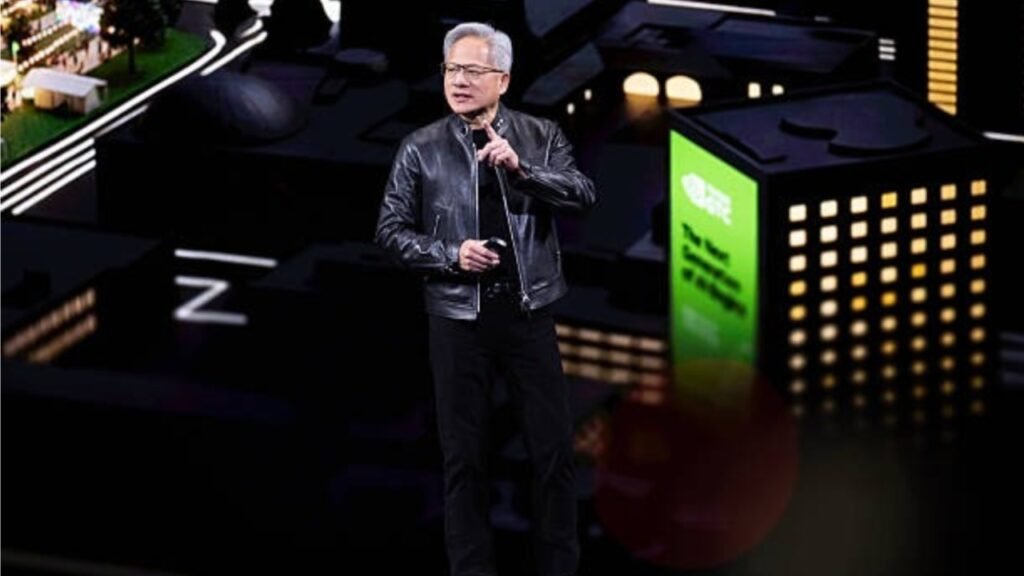
The community has been sceptical, irrespective of assurances from Huang. An X user articulated the fear that’s underlying much of this criticism. As per the user, “The fact you can dial in the style with AI is exactly why it’s bad. Game studios won’t hire artists if they can just prompt the style. AI can already replace coders, writers and voice actors. All game development will just be five vibe-coding tech bros in a trench coat.”
NVIDIA attempted damage control via additional statements, noting that DLSS 5 is an early preview and that this model continues optimization before its fall 2026 release. It’s been stressed by the company that developers could fine-tune neural rendering effects to preserve their games’ unique aesthetics.
Despite this, Huang acknowledged this pattern. He compared the reception to when ray tracing first debuted in 2018. Recalling, he said, “Everybody pooh-poohed it. Everybody said ray tracing was FUBAR.” He added, “If we didn’t have RTX today, doing full scene path-tracing, computer graphics wouldn’t be what it is today.”
Now, whether DLSS 5 follows just a small trajectory from criticism to acceptance is totally uncertain. However, the fall release would ultimately determine if the gamers embrace this AI-powered future or if they will reject it as a tech that fixes what wasn’t ever broken.

