
There are a total of 6 types of weapons that you will be able to use in Monster Hunter Stories 3. Each of them is quite unique and versatile in what they bring to a fight, and they are further subcategorized based on the damage type that they come with.
You can carry three weapons at a time on your Ranger. While you can specialize in one single type, it’s important to keep in mind that each monster part is weak to a particular type of damage.
So it’s best to be versatile with your options and lean towards having three different weapons, each of a different damage type.
Now, to master combat in the game, you will need to have a firm understanding of how each weapon works and the role they play in every encounter.
All Weapon Types explained in Monster Hunter Stories 3
1) Pierce Weapons
- Bow
- Gulance
Bow
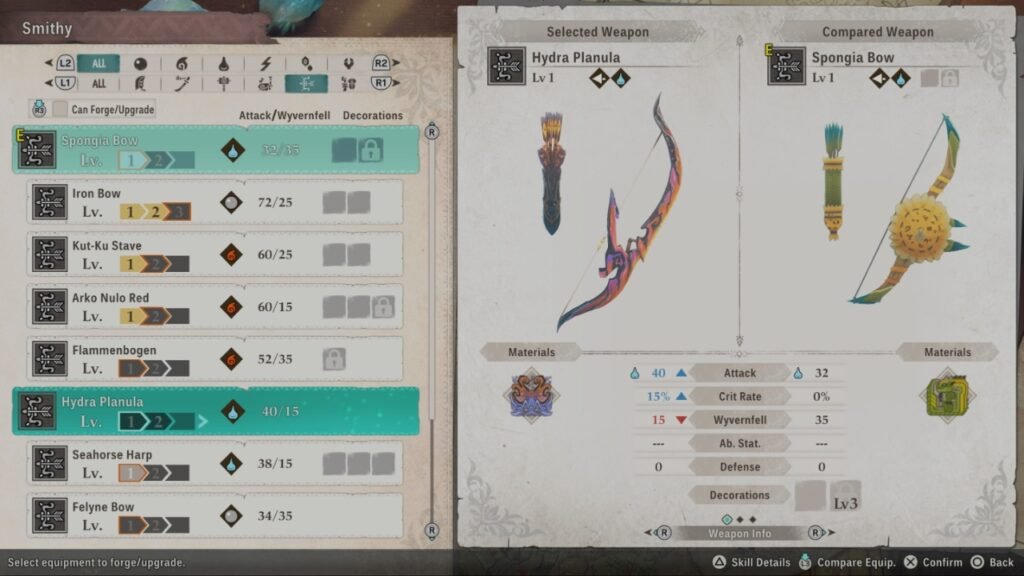
The Bow is all about setting the tempo of a fight. The weapon excels at debuffing enemies and applying abnormal status effects on them.
The Spongia Bow, for example, comes with debuff coatings like Exhaust and Accuracy down. And once you apply the coating, it persists and gains power, relative to the Charge Gauge level.
So the first hit will provide Accuracy Down (S), which will then move onto (M) and (L) as you keep applying it while raising the Bow’s charge level.
You fill up the Bow’s charges by using other skills. For the Spongia Bow, the Quick Shot (HVY) increases Charge Gauge by 1. The Spread Shot skill, on the other hand, will increase Charge Gauge by 2.
Once you have filled up the gauge, you will be able to use the Bow’s special attack, which, in the case of the Ludroth Bow, is the Dragon Piercer (CRSH).
Aerial Aim is the other special skill, and in the early game, you will find it in Bows like the Kut-Ku Stave and the Seahorse Harp.
Apart from the debuffs, you will also get to use Abnormal Status Effect coatings like Blast, Flash, Paralysis, and more. They work in the same way, as they too persist and gain power relative to Charge Gauge. So the higher your gauge, the more your chances of applying the effect on the monster.
So when it comes to the longer and more powerful encounters, the weapon is amazing at weakening the monster and making the fight more manageable.
Gunlance
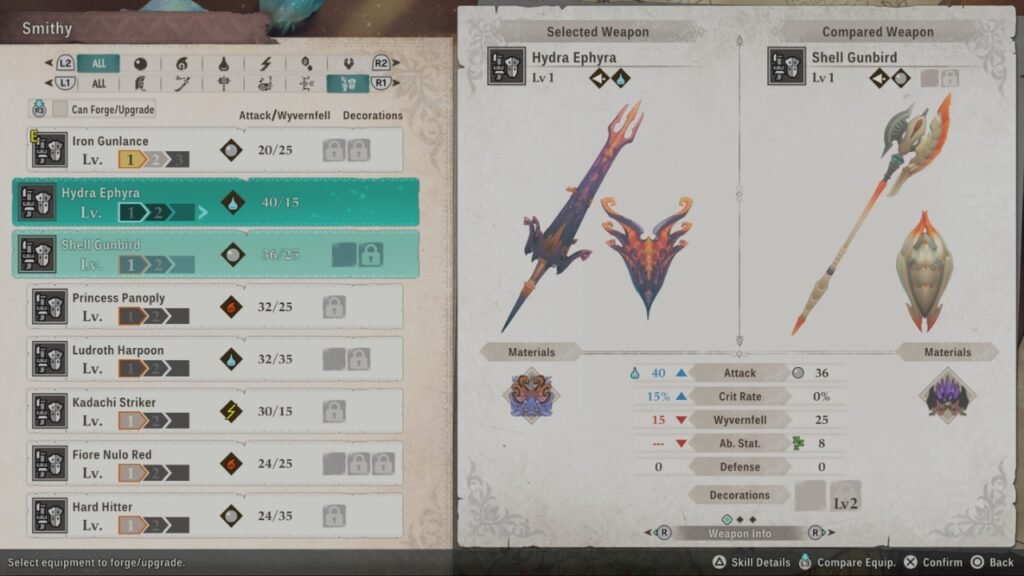
The Stories 3 Gunlance features a lot of improvements over its Stories 2 version. Unlike in the previous game, you now start with all the shells loaded.
The Wyvern Fire is also significantly more powerful, but is limited by a cooldown system. But like in Monster Hunter Rise, you will be able to use the Hail Cutter to use more of the attack.
The weapon offers a perfect balance between offense and defense. While tanking hits for your party, it can also dish out a significant amount of damage with its Shelling Skills.
Another big new change in Stories 3 is that every single Gunlance has different skills available. There are also several types of reload that you will gain access to, along with two versions of special skills, being the Wyvern Fire and the Wyvern Blaze.
Wyvern Blaze hits all enemies, requires more stamina, has double the cooldown, but hits significantly harder.
As the Gunlance’s Ammo Gauge replenishes when you win out on Head-to-Heads, you might want to rely on using one of your several shell-type attacks here instead of going for a double attack.
A basic Shelling attack is the cheapest option for this; however, if you are running low on ammo, you can always choose to go for a normal or double attack in head-to-heads.
Some Gunlances, like Namielle’s Hydra Ephyra has a Tactical Reload option that lets you deal damage to one enemy with the weapon element while loading two shells. So if you win a head-to-head with this attack, you will be able to reload the gauge by a lot.
Moreover, all Shelling skills give you a Guard buff, whose potency will depend on the type of skill that you are using.
Burst Fire will use all 8 of your shells and use up three times the Stamina, but will deal way more damage and provide you with the Guard (L) benefit instead of the normal Shelling’s Guard (S) buff.
The Charged Shelling, on the other hand, is in the middle; it uses 20 Stamina and 5 shells, does moderate damage, and gives the Guard (M) benefit.
Having the Guard buffs is absolutely important when the monster is about to do a Yellow attack, as it can’t be countered. However, do keep in mind that while Guard can reduce incoming damage by a lot, it cannot prevent stat abnormalities.
You can further supplement this with the Taunt Skill, which will let you get the head-to-heads. When used on a monster, it will stay in effect for around 2-3 rounds, which will significantly reduce the rng of the encounter.
The game plan with the Gunlance is simple: you start the encounter with a taunt, and then decide whether you want to use a Shelling for a head-to-head, or conserve ammo and stamina by going for a double or regular attack. And once you have enough stamina, you then blast the monster with your Wyvern Fire if you are absolutely certain that you won’t get attacked that round.
2) Blunt Weapons
- Hammer
- Hunting Horn
Hammer
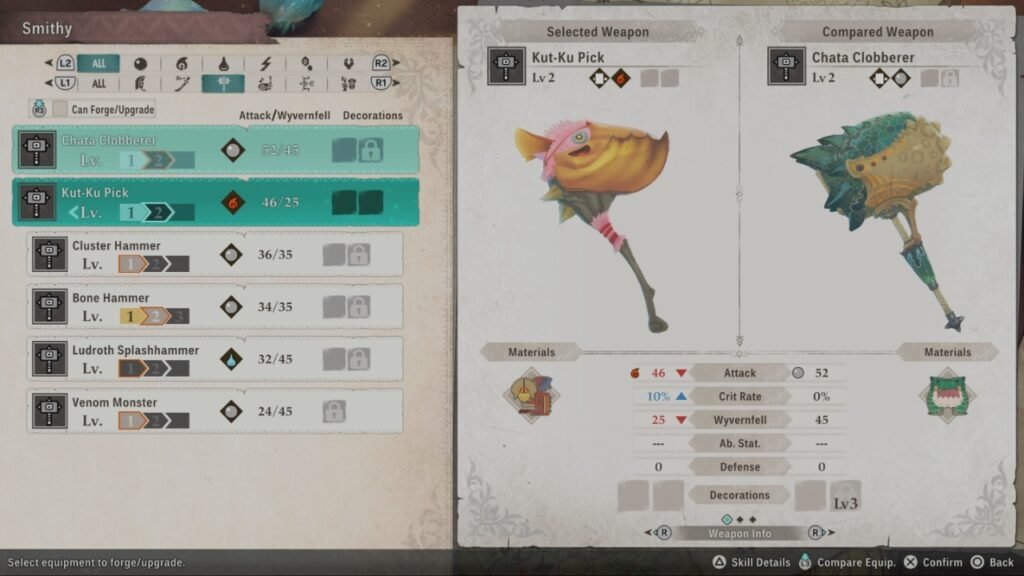
Hammer just goes bonk. It’s the simplest weapon in the game, does massive blunt damage, and is the perfect tool for breaking parts and chipping away at a monster’s Wyvernsoul Gauge.
Winning head-to-heads with Hammer skills also reduces the amount of stamina consumed while simultaneously increasing the damage you deal to the Wyvernsoul Guge.
There isn’t much to talk about when it comes to the hammer. Just keep in mind that no other weapon does a job better at staggering and toppling monsters
Hunting Horn
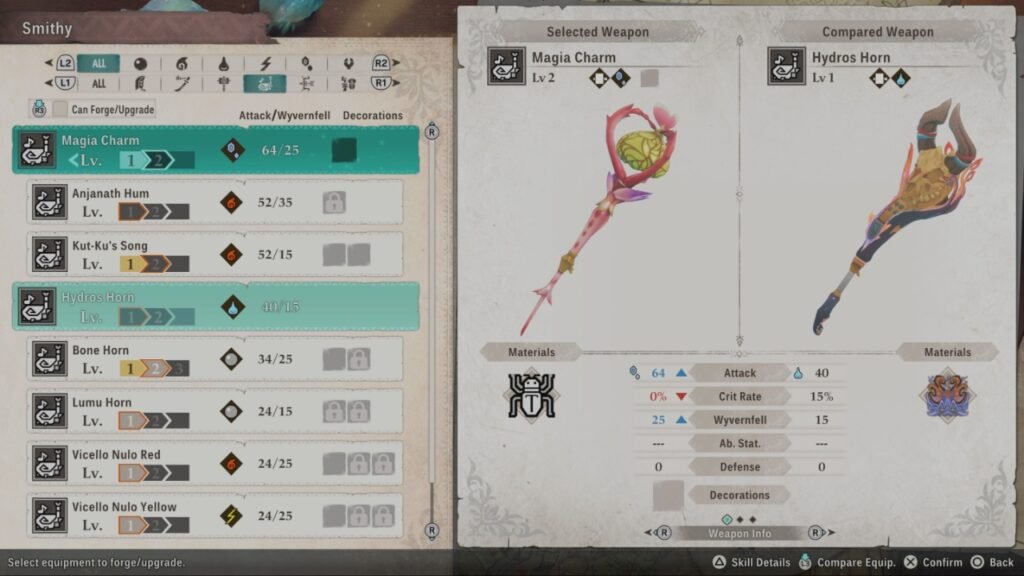
The Hunting Horn is the second blunt option in Stories 3 and is widely considered by many to be one of the more complicated weapons in the game.
It’s a support tool that provides party-wide buffs and heals by playing notes and then stringing them up into a song, which will then allow you to use a special attack.
The color of the notes that you play will depend on the type of attack that you are using. Power attacks will give you a red note, Tactical attacks will give you a green note, and Speed attacks will give you a blue note.
Now, to use a special attack, you will need to string up these colored notes into a specific order, which will then be consumed upon execution. Every Hunting Horn has a different special attack requiring their own unique combinations.
For example, the Magia Charm’s Pulsing Melody skill can be activated only after performing a Magnificent Trio when four note colors are on the musical staff in the mentioned order: Green > Blue > Red > Green.
Now for Namielle’s Hydros Horn’s Abyssal Melody, you will need to play the Magnificent Trio when notes are in the following order: Green > Blue > Green > Green.
So much of your playstyle with the Hunting Horn will revolve around how you are stringing up the notes and making the most of the special skills.
Here, you may be wondering how you will be able to effectively string up the notes in the correct order if the monster targets you with attacks, forcing you to go into a head-to-head.
For example, let’s say for the Pulsing Melody, you were able to string up Green and Blue, which are the first two notes. Red is the third one that you need, but the monster is targeting you with a Speed attack.
As Speed is countered by Technical, you will get a Green note by performing the head-to-head. Now this is where the Double Attack feature comes in. If you pull off a Double Attack with your monstie, you will receive a Rainbow Note instead.
The Rainbow Note is like a UNO Wild Card, and is considered to be of any color. So it will help fill in the gap for the Red note of the string.
Different Hunting Horns have different attacks and special skills. So the one that you want to have in your rotation will depend on the monster that you are up against and the sort of playstyle that you are going for.
One really cool improvement that Hunting Horn has received in Stories 3 over Stories 2 is that most of its attacks that provide a buff also deal damage to the enemy monster. However, that is not the case for every move, as certain skills like the Bone Horn’s Kinship Chorale grant Kinship Charge Up to all allies without doing any damage.
As Hunting Horn is pretty technical in its execution, you will want to get more familiar with every matchup as early as possible.
3) Slashing Weapons
- Great Sword
- Long Sword
Great Sword
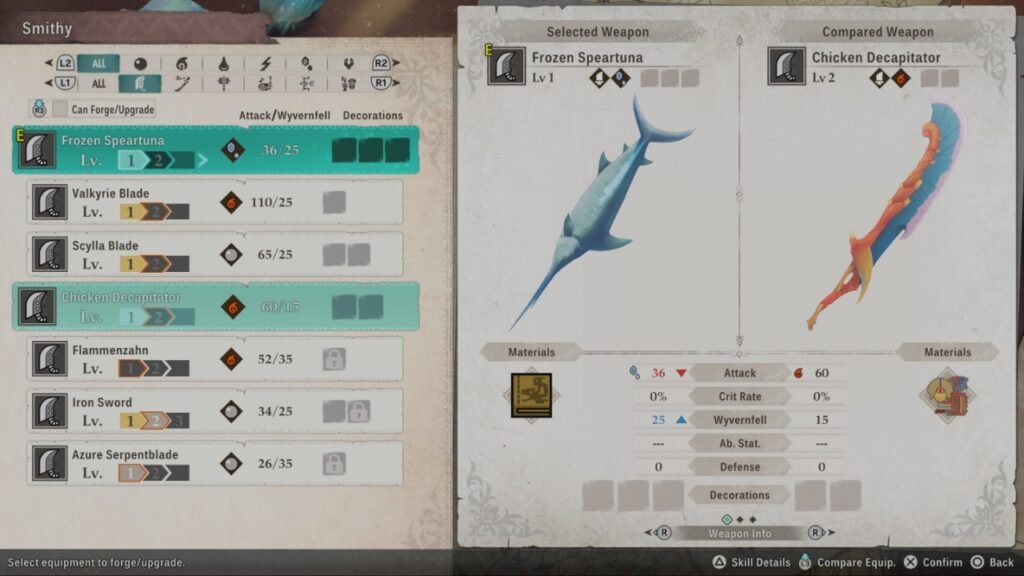
The Great Sword is another very simple weapon in Monster Hunter Stories 3. It’s specifically made to do a great deal of damage to the monster.
It comes with a Charge Gauge system, which increases the power of skills in proportion to the level of the gauge filled.
You fill up the gauge by performing charge actions like Charge or Charge Tackle, where the latter will damage the monster while filling up a gauge. Charges can also be acquired by winning head-to-heads and performing a Double Attack.
You then expend the charge by performing one of the many slash attacks. The more gauge a slash attack uses, the greater its damage potential.
- A Slash attack will retain the charges that you have. It will not consume a charge, nor will it give you one.
- A Charged Slash and a Wide Slash attack will consume one Charge Gauge.
- A Strong Charged Slash and a True Wide Slash will require Charge Level 2.
- A Rage Slash will consume all three levels of Charge.
If played perfectly, a Great Sword will be able to end encounters in minutes. It’s a DPS powerhouse that can bully the toughest of monsters once you have the perfect build and set-up going.
Long Sword
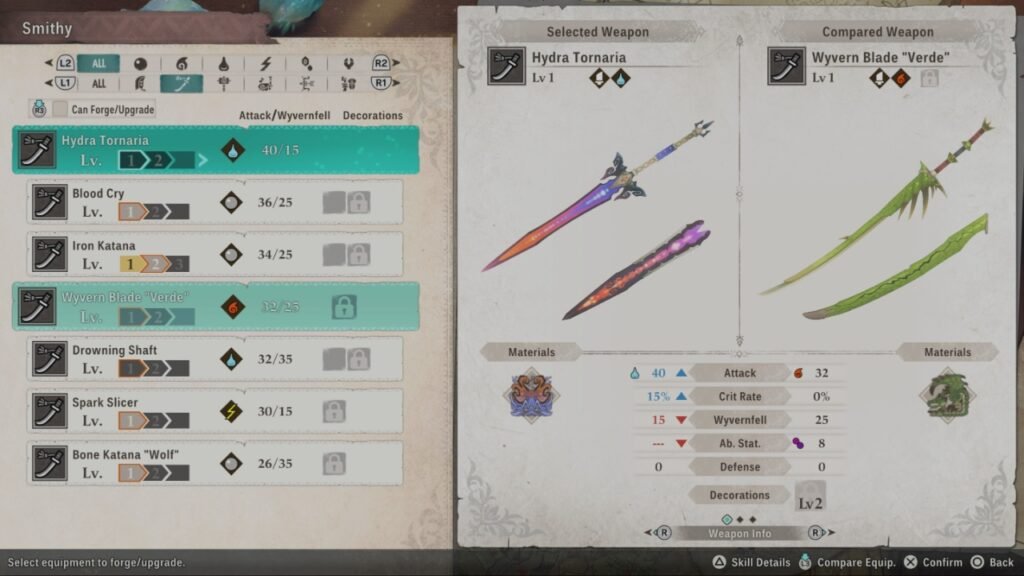
The Long Sword replaces the Sword and Shield from Stories 2. It’s a slashing weapon that plays differently based on the state it’s in.
In a Draw Weapon state, you will fill up its Spirit Gauge charges by winning head-to-heads or performing certain moves. The weapon also increases in attack power and Crit Rate according to the color of the gauge. You will then gain access to Stance Skill once the gauge is charged, and then transition into Special Sheathe state after using that Skill.
While in the Special Sheathe state, you will consume the Spirit Gauge and perform follow-up attacks based on the Stance Skill you are using. Your normal attacks are also enhanced, and the number of turns the Sheathe state is active for is determined by the gauge color. The state also lets you use Spirit Release Slash.
A Spirit Release Slash lets your Ranger consume all Spirit Gauge, get Critical Eye (crit chance), and the ability to counter one enemy attack with the weapon element. But it will remove the Special Sheathe after countering or at the end of that turn.
You will come across two Stance Skills in the early game, Retaliation and Lunge. Retaliation lets you launch counterattacks after the enemy attacks, while Lunge lets you do follow-up attacks on the monster after allies attack. Each requires Spirit Gauge 1 or higher to perform.
Apart from the Spirit Release Slash, another way of going back to the Draw state is to use the Unsheathing Strike.
So much of a Long Swords game plan will be to constantly switch between the two stances to maximize your DPS on the monster. You charge up the Spirit Gauge via head-to-heads and then make the most of the two Stances to keep chipping away at a monster’s HP.
Certain Long Swords will have other explosive special moves whose damage will be tied to the amount of Spirit Gauge you have acquired. Namielle’s Hydra Tornaria has the Spirithelm Breaker move, which consumes the entirety of the Spirit Gauge and deals heavy damage to one monster relative to the charge level.
Long Sword can be an incredibly powerful weapon once you master its mechanics and learn the monster patterns by heart.

