
Some of the most iconic JOJO poses have become cultural phenomena in recent decades. The anime was already super popular all over the world and helped revitalize this franchise in the late 80s.
Many do not know that most of these poses are actually homage to iconic fashion illustrations and photographs. This is because the creator, Hirohiko Araki, is a huge fan of fashion and music.
We have listed down some of the most iconic poses so far in the series’ history. Alongside, the an actual reference to the original image sources.
Origins Of The Most Iconic JOJO Poses
Phantom Blood Volume 4 Cover
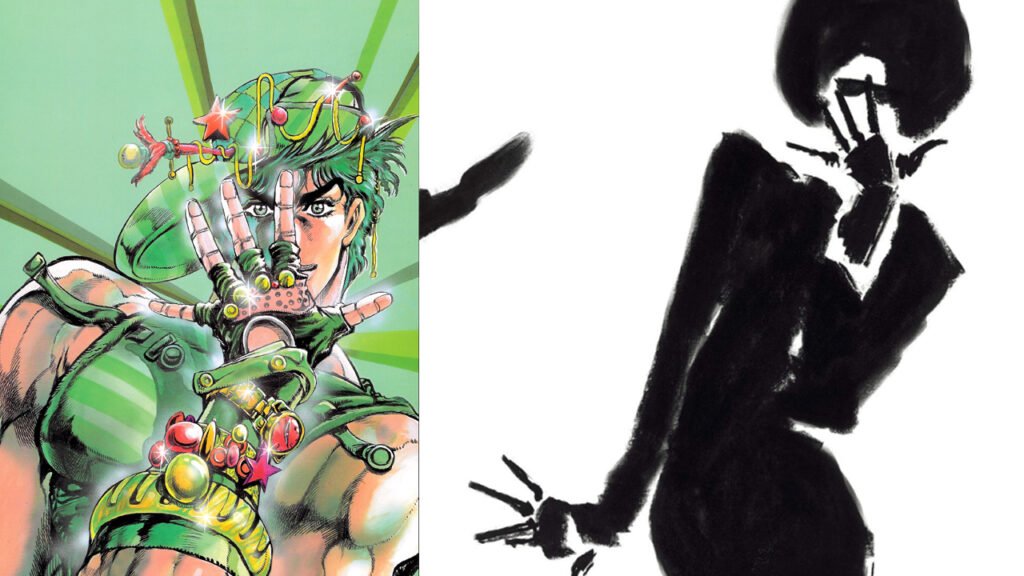
Jojo’s Bizarre Adventure is a long-running series, and Phantom Blood was the first part of the series. It follows the origins of the Joestar bloodline and also gives us our first introduction to Dio Brando.
The fourth volume of the manga has our JOJO protagonist hitting an iconic pose. Jonathan Joestar, waving his hands in front of his face, has become synonymous with pop culture. But it is not something that the author Hirohiko Araki suddenly came up with.
Araki is a huge fan of fashion, and this pose originates from the works of Tory Viramontes. Specifically, her fashion illustration from Studies of Teri Toye Body Conscious New York, 1963.
Weekly Shonen Jump 1987 Issue #10

This one is another iconic pose from the very early days of the series. It’s Jonathan Joestar, the main protagonist, again, but with an even more unconventional pose. It comes from the 10th issue of the series, which was released on February 3rd, 1987.
We see Jonathan Joestar hitting a pose as if to wipe off the blood from his arms, as his scarf floats in the air. This pose is inspired by another fashion illustrator’s work from 1984, Antonio Lopez, who was a Puerto Rican fashion illustrator.
This particular pose of Jonathan can be found in the G.Q. Magazine 1984’s “Patterns and Textures in Hand Knits”. Antonio was labeled a major fashion illustrator for years. Araki, being a fan of his works, would go on to reference more of his works later.
Battle Tendency Issue 18/25
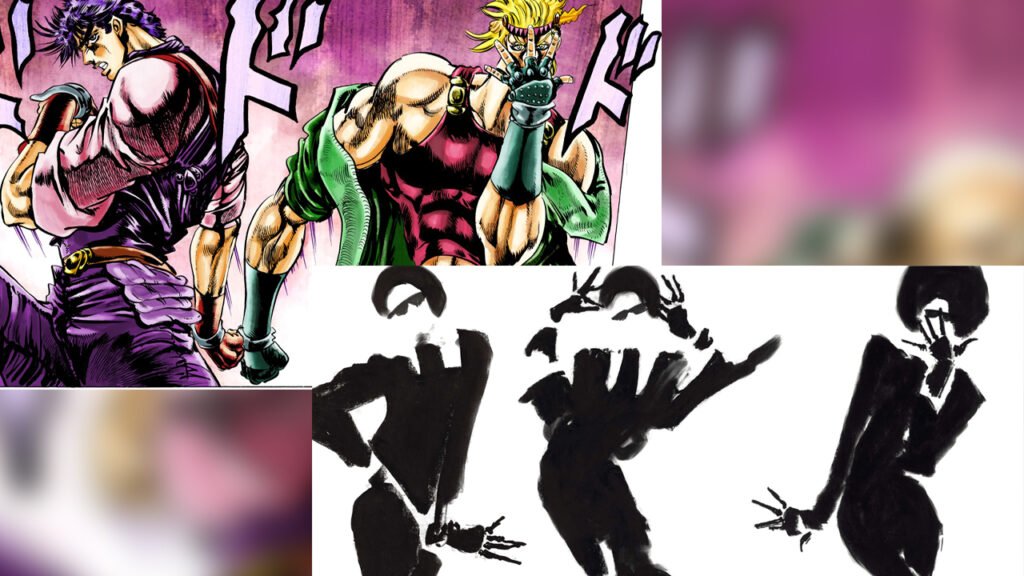
It can be argued that Hirohiko Araki is a huge fan of the hand-waving pose. Especially the works of Tory Viramontes. Because it appeared again in the second part of the JOJO franchise, Battle Tendency.
Battle Tendency follows the story of Joseph Joestar, uncovering the mystery of the phantom blood stone masks. With this, the series delves deeper into the explanation of hamon powers and abilities.
Joseph tags along with Ceaser Anthonio Zeppeli, the grandson of Will A. Zeppeli. Together, they strike this iconic pose twice in the show and have since become pop culture icons. The pose originates from the same works of Tory Viramontes from 1963.
Weekly Shonen Jump 1989 Issue #23
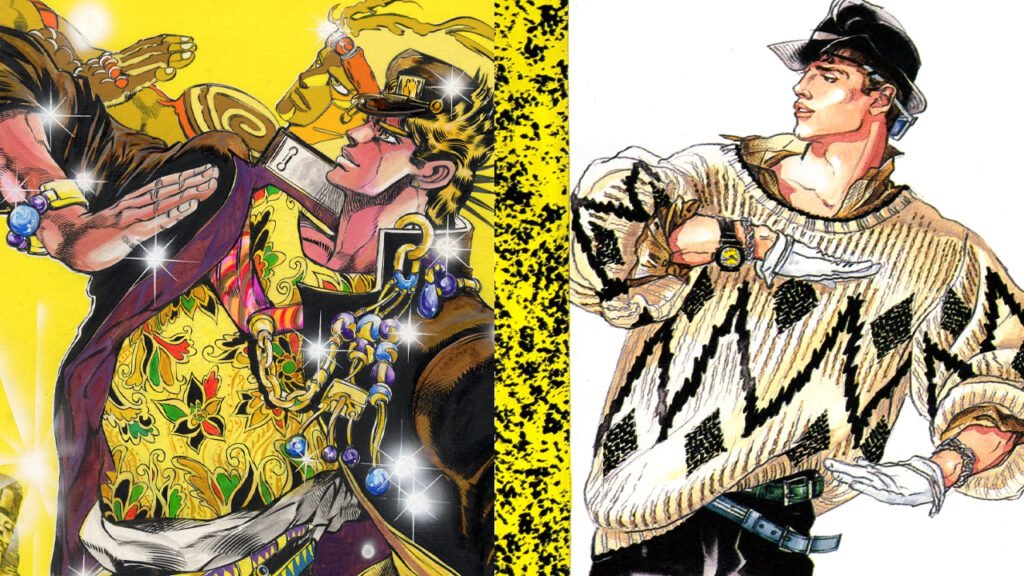
One of the most iconic poses of the most iconic JOJO protagonist has to be the cover art from Weekly Shounen Jump Issue #23. Jotaro is pretty much the poster child of the franchise. Even if we don’t see this pose much in the anime, it is iconic on the covers of the manga.
Jotaro is the protagonist of the third part in the series titled ‘Stardust Crusaders’. Dio Brando makes a comeback with newfound powers of vampirism. The series also sees the first-ever introduction of the iconic stand abilities.
The pose that Hirohiko Arakia was influenced by for this cover was once again from the works of Antonio Lopez. This one comes from “Patterns and Textures in Hand Knits”, G.Q. Magazine, 1984.
Weekly Shonen Jump 1989 Issue #19
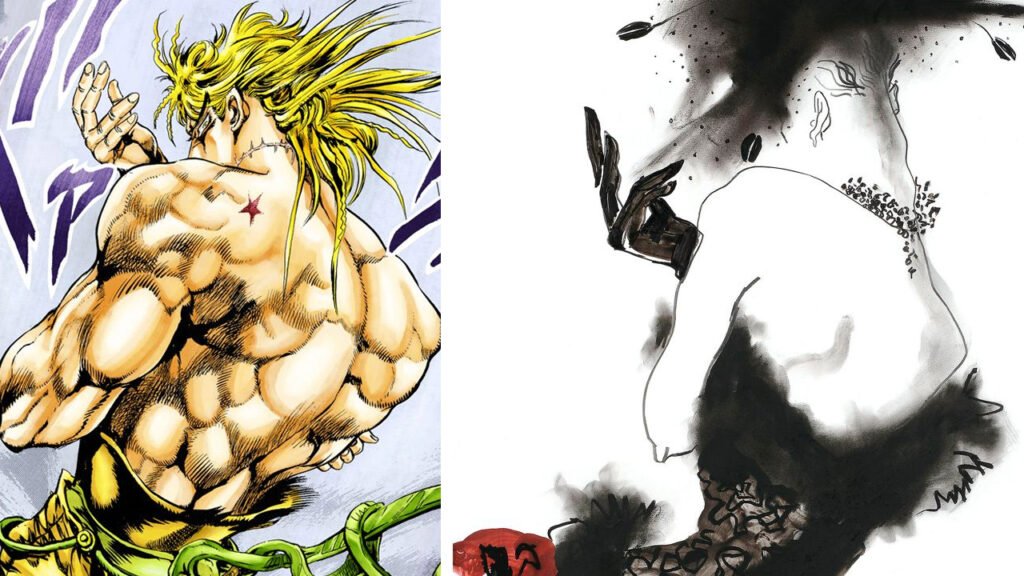
This is probably the most iconic image of Dio Brando ever and of the JOJO franchise in general. We see the series’ iconic villain pose with his bare back turned to the viewers, with the Joestars mark fully exposed.
Dio is not a part of the Joestar bloodline, but going into a bit of spoiler territory, we have to discuss the mark on his shoulder. It comes from the fact that he stole the body of Jonathan Joestar.
This particular pose of Dio comes from another famous work of the fashion illustrator, Tony Virmontes. Particularly his work for Nina Ricci fashion house’s Haute Couture, 1984. It keeps coming back in other popular media and is reused in other JOJO parts as well.
Jump Comic Volume 42

Diamond is Unbreakable, which is the title for the fourth part in the JOJO franchise, has a lot of iconic poses. This part minimizes everything we have previously experienced with the series, bringing globe-trotting to a halt.
It focuses on the small Japanese town of Morioh from the 90s. This particular pose of the protagonist, Josuke, has him in a different outfit as opposed to his usual one. He sports a lot of winterwear underneath what appears to be his school uniform.
The inspiration matches with the iconic work of fashion photographer Bruce Weber, to a tee. Specifically, his work for Gianna Versace Fall/Winter 1984. The model, John Hanrahan, is seen posing with the same style of winter wear.
Weekly Shonen Jump 1994 Issue #8
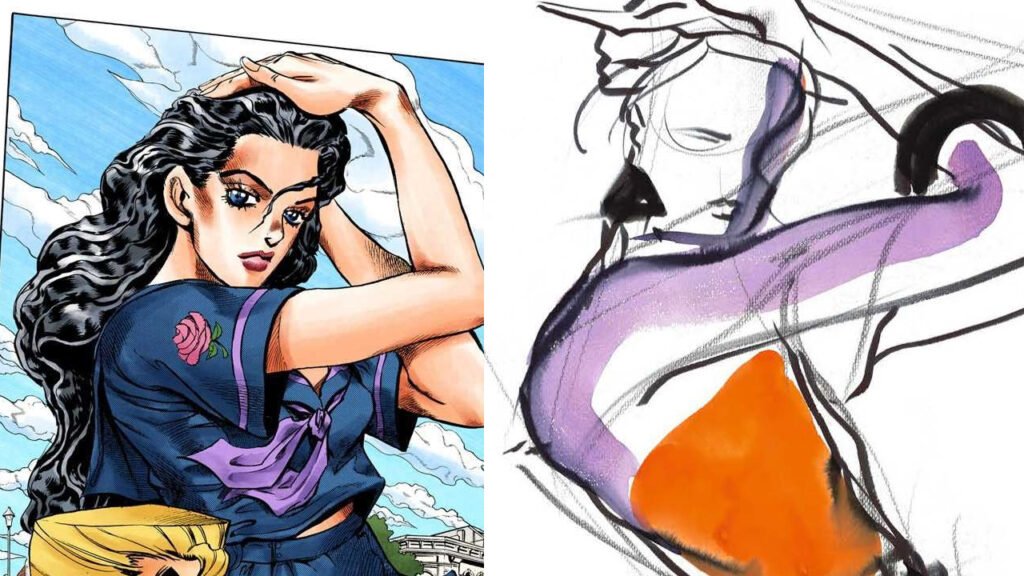
This is one of the few iconic images from the show, which is not a pose of the protagonist but rather a supporting character. This iconic pose was hit by the character Yukako Yamagishi, who had her own character arc with Koichi Hirose.
At first, Yukako seemed like a character who was romantically involved with Koichi, but very soon, it turned out to be an overpossessive nature. In the image, we see Yakako’s unique dark hair in full display, which is also her biggest weapon, her stand, Love Deluxe.
The pose is referenced from another work of the popular fashion illustrator Tony Viramontes. This time from Christian Dior’s “Miss Dior”, Paris, 1986. The piece is called Bold, Beautiful and Damned. It reappears in future parts of the JOJO franchise.
Weekly Shonen Jump 1994 Issue #32
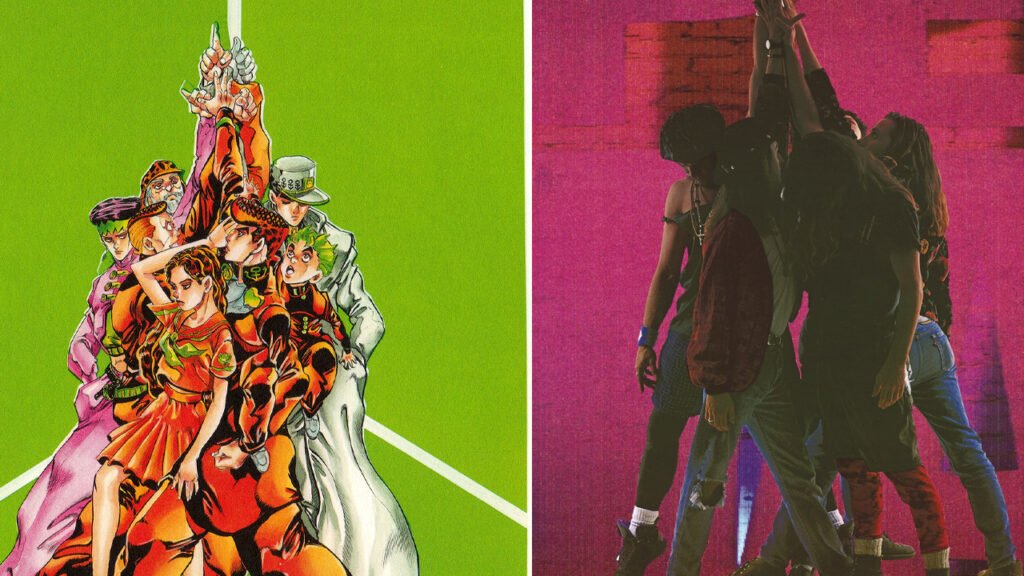
Diamond is Unbreakable probably has the most iconic group pose out of all the JOJO parts. On the cover of Issue #32, we see the whole gang come together to point up at the sky, and yes, Jotaro is back in this one.
This pose was also referenced in the intro for the anime adaptation of Diamond is Unbreakable. This time, the reference does not come from a fashion illustration but rather an album cover. Hirohiko Araki is a huge fan of music, and the culture is reflected throughout his works.
This particular group pose is inspired by the debut album cover of Pearl Jam in 1991. The cover has members from the band posing together, pointing upwards.
Weekly Shonen Jump 1996 Issue #9
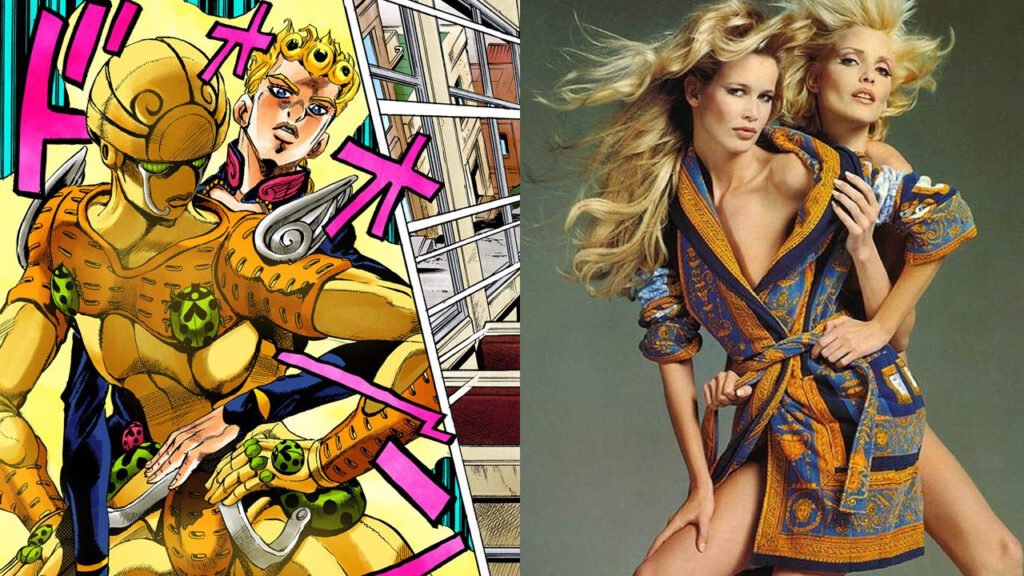
JOJO part 5 or Vento Aureo takes us away from Japan and to Italy. The plot this time tackles a mafia story following Giorno Giovanna, who is also called GioGio by fans. When the anime aired, the title was translated to Golden Wind.
The origin of Giorno is very interesting and will come as a shock to many fans if you haven’t watched the series yet. But we are here to talk about the gorgeous art in issue #9 where we see Giorno posing with his stand, Gold Experience.
There are many iconic JOJO poses out there that have the character posing with their stands. But this one takes the cake out of them all. It references a popular Versace cover photograph of models Claudia Schiffer and Nadja Auermann, clicked by Richard Vedon.
Weekly Shonen Jump 1999 Issue #1
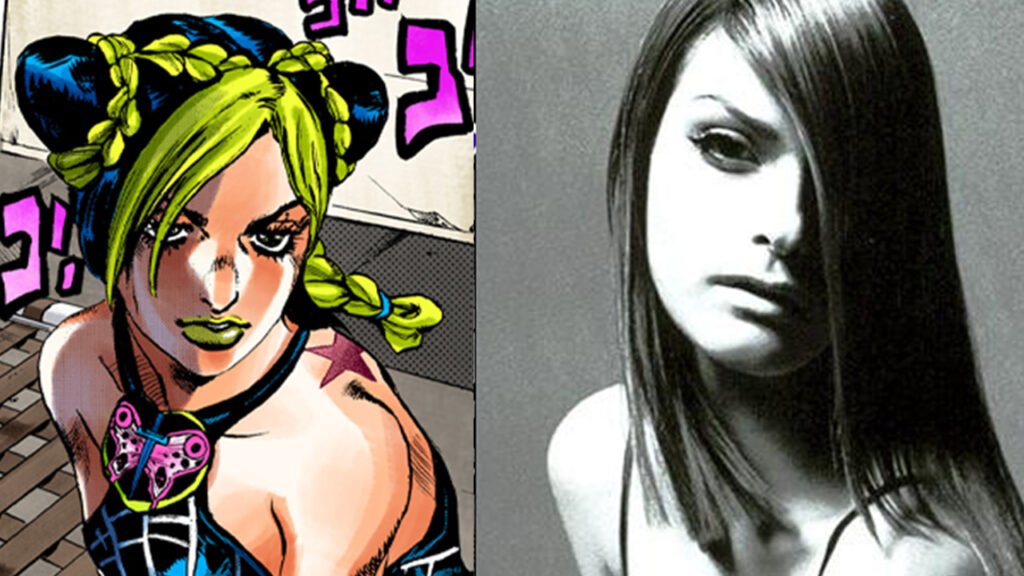
Stone Ocean is the 6th part in the long-running franchise, and it stars Jolyne Kujo, the daughter of Jotaro Kujo. She finds herself in a high-security prison after being framed for an accident.
This pose of hers is our first introduction to her as she appears on issue #1 of the series, as well as the first episode of the anime. It is also an establishing shot of Jolyne, as this is the first time we were getting a female JOJO protagonist.
The iconic pose is referenced from a photograph from 1998’s Vogue Italy magazine. Clicked by photographer Steven Meisel.

